
PSPO Certification

PSPO Certification is a great way of validating the Scrum and Product Ownership knowledge. To pass the PSPO I, you have to get an 85% score or higher on an 80-question timed test in 60 minutes, similar to the Scrum Open assessment. The central role of the Scrum Team is the Product Owner role whose responsibilities are Optimize Return on Investment (ROI) and Total Cost of Ownership (TCO) for the Development Team’s work. Along with other responsibilities are creating and sustaining a Product Backlog that maximizes value and represents the needs of the stakeholders.

Purchase Udemy Membership to access PSPO Questions with helpful explanations.


PSPO Certification Subject Areas

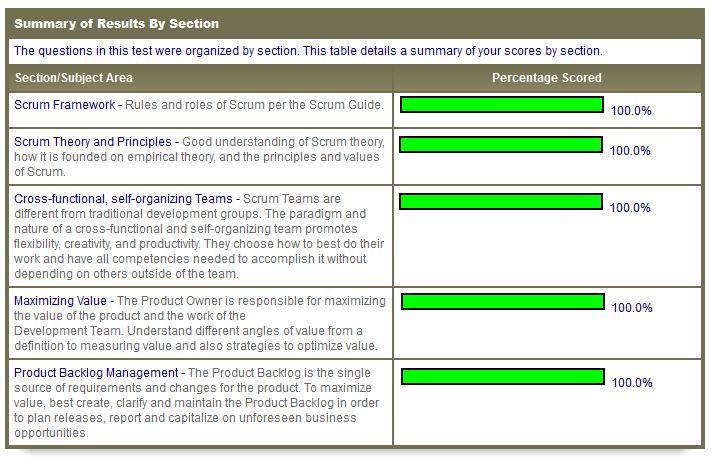
The Scrum Product Owner is responsible for maximizing the value of the product resulting from the work of the Development Team. There are five subject areas. Therefore, each subject area covers a specific topic.

Based on feedback from exam takers, the rough breakdown of knowledge areas tested includes:

  • Scrum Framework and Theory: 25–30%
  • Product Owner Roles and Responsibilities: 20%
  • Product Backlog Management: 10%
  • Cross-Functionality and Self-Managing: 10%
  • Maximizing Product Value: 10%
  • Forecasting & Release Planning: 5–10%
  • Product Vision and Value: 10%
  • Business Strategy, Stakeholders & Customers: 10%

PSPO Certification Focus Areas

PSPO Certification


PSPO Study Materials

Primary Study Sources

  1. The Scrum Guide (2020 Version)
    The Scrum Guide is the official and authoritative source for Scrum knowledge. It outlines the roles, events, and artifacts of Scrum in a concise format.
  2. Scrum Glossary
    A glossary of key Scrum terms and definitions to enhance your understanding of Scrum vocabulary.
  3. Evidence-Based Management Guide (EBM)
    Provides insight into measuring value and outcomes to improve product and organizational agility.
  4. Scrum.org Learning Path
    Guides learners through key competencies and skill areas relevant to Scrum and the Product Owner role.

Other Recommended Sources

  • Professional Scrum Product Owner Book – by Don McGreal and Ralph Jocham
  • Scrum Open Assessment – Free practice from Scrum.org
  • TechAgilist PSPO Practice Exams – Multiple levels of quizzes with explanations
PSPO Certification Exam Format


Aspect Details
Questions 80 questions
Time Limit 60 minutes (45 seconds per question average)
Passing Score 85% (minimum 68 correct answers)
Question Types Multiple choice, multiple answer, true/false
Language English only
Cost $200 USD per attempt
Format Online, open-book (though limited time makes this impractical)
Certificate Validity Lifetime (no renewal required)

Free Practice Exams

Open Assessments from Scrum.org
These are absolutely essential for preparation:

  • Scrum Open Assessment: Take until you consistently score 100%
  • Product Owner Open Assessment: Critical for understanding PO-specific concepts
  • Evidence-Based Management Open: Helps with EBM-related questions
  • Agile Leadership Open: Additional practice for leadership concepts

Recommended Practice Exam – Click Here

Tips and Tricks

  • Read and thoroughly understand the Scrum Guide.
  • Review the Product Owner Learning Path on Scrum.org.
  • Use the Open Assessments for practice and aim for 100% repeatedly.
  • Pay attention to “NOT” in questions and use elimination techniques for multiple-answer items.
  • Answer all questions—there is no penalty for guessing.
 

Question: How many levels are there in the Professional Scrum Product Owner (PSPO)?

Answer: PSPO has three levels: Foundation, Practitioner, and Master.

  • The Foundation level (PSPO I) is perfect if you’re new to PSPO or Agile in general. It will give you a good understanding of the basics and key concepts of the PSPO framework.
  • The Practitioner level (PSPO II) is ideal if you want to deepen your knowledge and learn how to apply PSPO in a real-world setting. You’ll also learn how to adapt the PSPO framework to specific situations and challenges.
  • If you’re an experienced Agile practitioner, then the Master level (PSPO III) is for you. This advanced level will test your knowledge and skills to the fullest, and upon successful completion, you’ll be able to take on complex projects and lead PSPO initiatives.

Conclusion

Success on the PSPO I exam requires more than surface-level Scrum knowledge—it demands deep understanding of product ownership principles, strategic time management, and thorough preparation using quality resources. The key to passing is consistent practice, mastery of the Scrum Guide, and understanding Evidence-Based Management concepts.

Remember that this certification represents a lifetime credential that validates your expertise in one of the most challenging aspects of Agile product development. The investment in thorough preparation will not only help you pass the exam but also make you a more effective Product Owner in your professional practice.

With the strategies, resources, and tips outlined in this guide, you’re well-equipped to approach the PSPO I certification with confidence. Focus on understanding over memorization, practice consistently with quality resources, and trust in your preparation when exam day arrives.

Good luck with your PSPO I certification journey!

Disclaimer: Professional Scrum™, Professional Scrum Master, PSM, PSM I, Professional Scrum Product Owner, PSPO, PSPO I, Scrum Open, etc. are protected brands of Scrum.org. Our content and practice exams are neither endorsed by nor affiliated with Scrum.org. All Scrum Guide–related content is sourced from scrumguides.org under the Attribution-ShareAlike license of Creative Commons. License details are available at https://creativecommons.org/licenses/by-sa/4.0/legalcode and summarized at http://creativecommons.org/licenses/by-sa/4.0/.

Scroll to Top

Tech Agilist UDEMY

PSPO I Practice Exams

650 PSPO I QUESTIONS