

PSPO Practice Exam Udemy Image

PSPO Practice Exam validates a professional’s ability to maximize product value through Agile principles and Scrum practices. As organizations increasingly prioritize customer-centric product development, this certification has become a benchmark for Product Owners seeking to bridge strategic vision with empirical execution. The Product Owner role is responsible for optimizing return on Investment (ROI) and Total Cost of Ownership (TCO) for the Scrum Team’s work. Along with other responsibilities are creating and sustaining a Product Backlog that maximizes value and represents the needs of the stakeholders.

** This practice assessment is based on the Scrum Guide v2020 & neither created nor endorsed by Scrum.org. **

Key Features & Benefits of PSPO I Practice Exam Simulator

Purchase PSPO I Practice Exams (650 Questions) via Udemy: Click here

  • High-quality questions: These simulated exams are designed to reflect the difficulty and complexity of the actual PSPO certification exam.
  • Realistic exam simulation: These simulated exams simulate the actual PSPO certification exam as closely as possible.
  • Detailed feedback and explanations: These simulated exams provide detailed feedback and explanations of why an option is correct or the remaining options are incorrect for each question.
  • Instant results & instructor support: These simulated exams provide instant results after each exam. Instructors are available on a demand basis.
  • Benefits of PSPO Exam Simulator: Identifying knowledge gaps, building confidence, simulating real exam conditions, and improving time management skills.
  • Reference Guides: You will be able to download reference guides – “Scrum Master – Product Owner Study Material” from the announcement section of this course.

PSPO Subject Areas

Focus Areas

Subject Areas

  • Scrum Framework: Rules and roles of Scrum per the Scrum Guide.
  • Scrum Theory and Principles: Good understanding of Scrum theory, how it is founded on empirical theory, and the principles and values of Scrum.
  • Cross-functional, Self-organizing Teams: Scrum Teams promote flexibility, creativity, and productivity. They are cross-functional and self-managing with all necessary skills.
  • Maximizing Value: The Product Owner is responsible for maximizing the value of the product and Scrum Team’s work. Learn strategies and metrics to measure and improve value.
  • Product Backlog Management: The Product Backlog is the single source of product requirements. Properly manage it to optimize planning, adaptability, and stakeholder satisfaction.
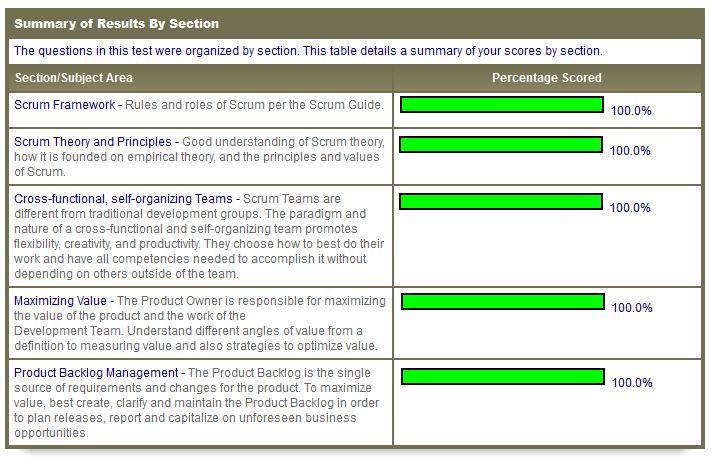
PSPO Practice Exam screenshot

PSPO Practice Exam Practice Mode

This PSPO I exam is in Practice Mode and it is from the question bank and has 50+ Questions. Hence, you will get a random set of 15 out of 50+ questions each time. The result is displayed as you answer the questions.

Number of Questions: 15
Passing score: 85%
Format: Multiple Choice, Multiple Answer, True or False

Frequently Asked Questions

General Information

Q: What is the PSPO I certification?
A: The Professional Scrum Product Owner I (PSPO I) certification is an industry-recognized credential offered by Scrum.org that validates your understanding of the Scrum framework and your ability to support value creation and delivery as a Product Owner. It demonstrates your knowledge of how to bridge the gap between strategy and agile product management to create valuable products using Scrum.

Q: What does the PSPO I certification validate?
A: PSPO I validates your fundamental understanding of the Product Owner accountability, including how to work with stakeholders, manage product backlogs, maximize value delivery, and apply Scrum principles in real-world scenarios.

Prerequisites and Requirements

Q: Are there any prerequisites for taking the PSPO I exam?
A: No, there are no formal prerequisites for taking the PSPO I assessment. While basic knowledge of Scrum in a real-world context is helpful, it is not mandatory. You do not need to attend a training course to take the exam.

Q: Do I need to attend a training course before taking the exam?
A: No, attending a training course is not mandatory. While the Professional Scrum Product Owner course is highly recommended, you can self-study and attempt the assessment to gain the PSPO I certification. However, attending a course can provide structured learning and increase your chances of passing.

Q: Is PSM I certification required before PSPO I?
A: No, PSM I is not a prerequisite for PSPO I. While having a good understanding of PSM I concepts can help, the Scrum Guide and PSPO-specific materials should be sufficient for preparation.

Exam Format and Structure

Q: What is the format of the PSPO I exam?
A: The PSPO I exam consists of 80 questions that must be completed within 60 minutes. The questions are in multiple choice, multiple answer, and true/false formats. The exam is available only in English.

Q: What is the passing score for PSPO I?
A: You need to score 85% or higher to pass the PSPO I exam, which means getting at least 68 out of 80 questions correct.

Q: How difficult is the PSPO I exam?
A: The PSPO I exam is considered challenging and has become harder over the years. Many experienced professionals, including those with PSM I, PMP, and CSM certifications, have found it difficult. The exam requires not just theoretical knowledge but the ability to apply Scrum principles to complex scenarios.

Cost and Retake Policy

Q: How much does the PSPO I exam cost?
A: The PSPO I exam costs $200 USD per attempt. If you attend an official Scrum.org course, one exam attempt is included for free.

Q: What happens if I fail the exam?
A: If you fail the exam, you will need to purchase another attempt for $200 USD. There are no free retakes unless you attended an official Scrum.org course and take the exam within 14 days of course completion.

Q: How soon can I retake the exam if I fail?
A: You can retake the exam immediately after failing, but you must purchase a new attempt. However, it’s recommended to take at least 1–3 days to reflect and study your weak areas before attempting again.

Q: Do assessment passwords expire?
A: No, assessment passwords do not expire and remain valid until used. You can take the exam whenever you feel ready.

Certification Validity and Renewal

Q: Does the PSPO I certification expire?
A: No, PSPO I certification is valid for life and does not require renewal or additional payments. Unlike Scrum Alliance certifications, Scrum.org certificates are lifelong.

Q: Do I need to maintain the certification?
A: No maintenance is required for PSPO I certification. Once earned, it remains valid indefinitely without the need for continuing education units or renewal fees.

Exam Content and Preparation

Q: What topics are covered in the PSPO I exam?
A: The PSPO I exam covers several focus areas including Understanding and Applying the Scrum Framework (Empiricism, Scrum Team, Events, Artifacts, Done), Developing People and Teams (Self-Managing Teams), and Managing Products with Agility (Forecasting & Release Planning, Product Vision, Product Value, Product Backlog Management, Business Strategy, Stakeholders & Customers).

Q: What percentage of questions come from different topics?
A: Based on feedback from exam takers, the approximate breakdown is: Scrum Framework and Theory (25–30%), Product Owner Roles and Responsibilities (20%), Product Backlog Management (10%), Cross-Functionality and Self-Managing (10%), Maximizing Value (10%), Forecasting & Release Planning (5–10%), Product Vision and Value (10%), Business Strategy and Stakeholders (10%).

Q: What are the essential study materials?
A: The essential study materials include the Scrum Guide (primary source), Evidence-Based Management Guide, Scrum Glossary, and Product Owner Learning Path on Scrum.org. The Scrum Guide should be read multiple times as it’s the primary source for exam questions.

Q: How should I prepare for the exam?
A: Key preparation steps include: reading the Scrum Guide thoroughly multiple times, taking Scrum Open and Product Owner Open assessments until you score 100%, studying the Evidence-Based Management Guide, reviewing the Scrum Glossary, and taking practice tests from legitimate sources.

Q: How long should I study for the exam?
A: Preparation time varies by individual experience, but many successful candidates report studying for 2–3 weeks to several months. Those with extensive Scrum experience may need less time, while beginners should allow more time for comprehensive preparation.

Open Assessments

Q: Are there free practice tests available?
A: Yes, Scrum.org offers free Open Assessments including Scrum Open, Product Owner Open, Agile Leadership Open, and Evidence-Based Management Open. You should take these multiple times until you consistently score 100%.

Q: How do open assessment scores relate to the real exam?
A: Open assessments are generally easier than the real PSPO I exam. Scoring well on open assessments is necessary but not sufficient for passing the real exam. The real exam requires deeper understanding and application of concepts.

Exam Day Tips

Q: What should I do on exam day?
A: Choose a quiet location with stable internet, read questions carefully (paying attention to negatives like “NOT”), manage your time to spend about 45 seconds per question, mark uncertain questions for review, and ensure you select the correct number of answers when multiple selections are required.

Q: Can I bookmark questions during the exam?
A: Yes, you can mark questions and return to them later if time allows. It’s recommended to answer all questions first, then use remaining time to review marked questions.

Q: Should I guess on uncertain questions?
A: Yes, there’s no penalty for wrong answers, so make educated guesses if you’re unsure. Don’t leave any questions blank.

Career and Value

Q: Is the PSPO I certification worth it?
A: The PSPO I certification can be valuable for career advancement, especially in organizations using Scrum. It demonstrates validated knowledge of product ownership and Scrum principles. However, the primary value comes from the learning process and knowledge gained during preparation.

Q: What salary can I expect with PSPO I certification?
A: According to various sources, Product Owners with PSPO certification can earn approximately $96,000+ per year, with Professional Scrum Product Owners earning about 20% more than non-certified professionals.

Q: How does PSPO I compare to CSPO?
A: PSPO I requires passing a challenging exam (85% passing score), while CSPO only requires attending a course with no exam. PSPO I is valid for life, while CSPO requires renewal every two years. PSPO I is generally considered more rigorous and testing actual knowledge rather than just course attendance.

Common Challenges and Misconceptions

Q: What are common reasons for failing the PSPO I exam?
A: Common reasons include insufficient preparation time, relying too heavily on easy practice tests, not understanding the depth required beyond the Scrum Guide, poor time management during the exam, and not carefully reading questions that may have multiple correct answers.

Q: Is memorizing the Scrum Guide enough to pass?
A: No, simply memorizing the Scrum Guide is not sufficient. The exam tests your ability to apply Scrum principles to real-world scenarios and challenging situations. Deep understanding and practical application knowledge are required.

Q: Can I use exam dumps to prepare?
A: Using exam dumps is strongly discouraged and can result in legal action, certificate cancellation, and lifetime bans from Scrum.org exams. Focus on legitimate practice tests and study materials instead.

Additional Certifications

Scroll to Top

Tech Agilist UDEMY

PSPO I Practice Exams

650 PSPO I QUESTIONS