
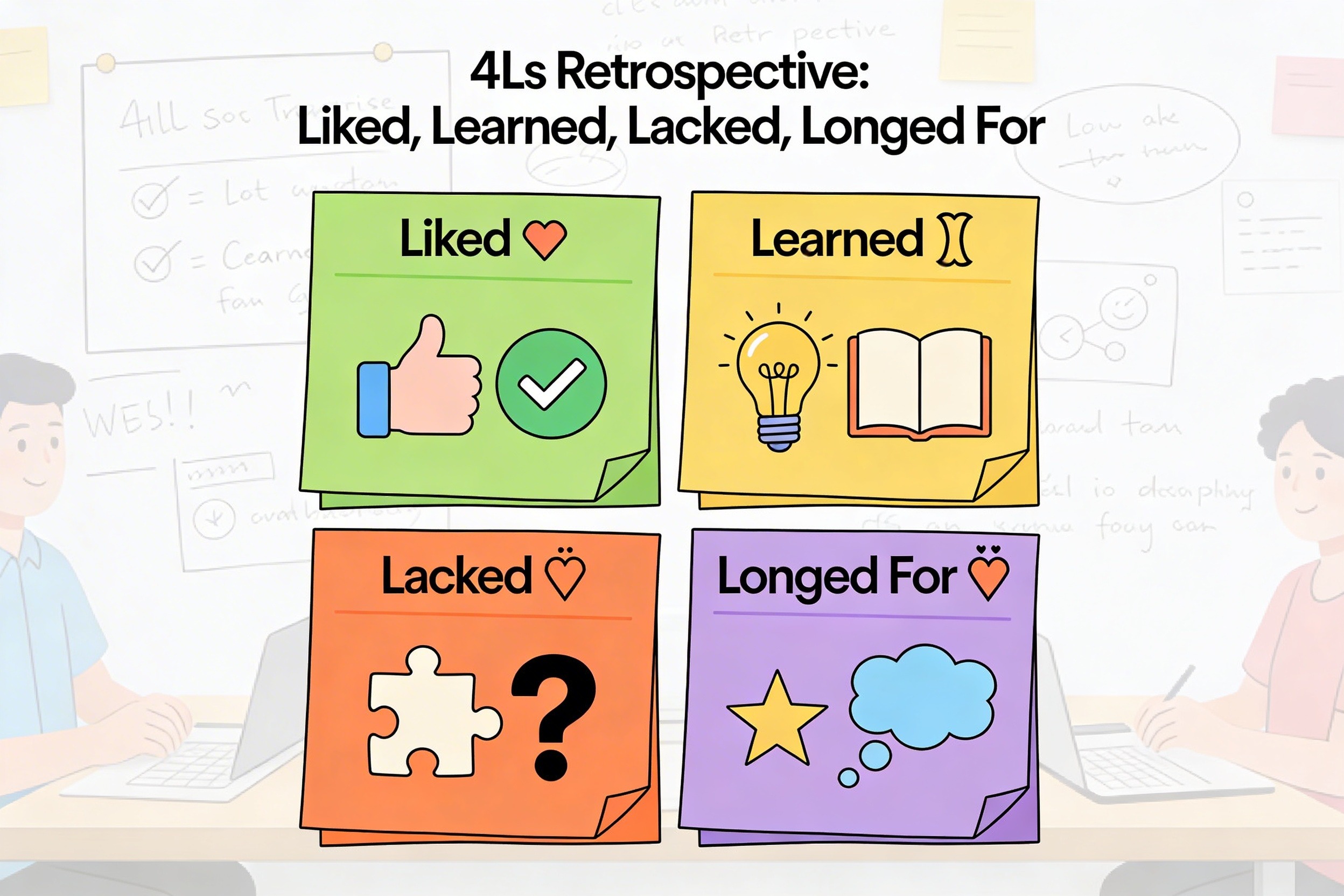
4Ls stands for Liked Learned Lacked Longed and it is a brainstorming technique for collecting feedback on a recently completed project or piece of work. This retrospective highlights the positive (liked & learned) as well as the negative (lacked & longed for).
The team has to think mostly from a factual (what happened) perspective, rather than an emotional perspective.
Liked – The first L in the 4Ls retrospective stands for “Liked.” In this phase, team members reflect on what they enjoyed about the project or sprint. This could include anything from successful outcomes to positive team dynamics or individual achievements. By identifying what went well, the team can build on their successes and replicate them in future sprints. What did the team like and enjoy about the last sprint run? This could be anything from a process, an achievement, a team action, or even a technology that went better than expected.
This might include:
- Practices that worked (pairing, mob sessions, daily check-ins).
- Positive team behaviors (supportive feedback, helping across roles).
- Process or tooling wins (smooth deployments, clear acceptance criteria).
Learned – The second L stands for “Learned.” This phase is about reflecting on what the team has learned during the sprint or project. This could include new skills, new information, or insights into the project or team dynamics. By acknowledging what they’ve learned, the team can identify opportunities for growth and development in future sprints. What things did the team learn from experiments, testing, and conversation and from working with each other? These are any new discoveries, points of interest, or highlights that can be technical (new way for testing) or non-technical (a new effective way to keep stakeholders informed).
This might include:
- Technical lessons (how a new library behaves in production, performance tuning discoveries).
- Product or user insights (new understanding of user behavior, market feedback, or usage data).
- Process learnings (what worked or didn’t in planning, estimation, or communication).
Lacked – The third L stands for “Lacked.” This phase identifies what the team felt was lacking during the sprint or project. This could include missing skills or resources ineffective communication or unclear goals. By acknowledging what was lacking, the team can address these issues in future sprints and work towards more successful outcomes. What was missing or could have been done better during the last iteration? On reflection, this might be something that was unclear or needed to be implemented to ensure that things continue to run smoothly.
Typical items include:
- Missing resources (environments, test data, licenses, or specific skills).
- Gaps in communication (unclear priorities, slow decision-making, unavailable stakeholders).
- Process shortcomings (no clear Definition of Done, unprioritized backlog, unstable CI/CD pipeline).
Longed for – The final L stands for “Longed For.” This phase is about identifying what the team wishes they could have had during the sprint or project. This could include anything from more time or resources to a more supportive team environment. By identifying what they longed for, the team can work towards creating an environment that supports their needs and facilitates success. What is something that they wish existed or was possible that would ensure that the project would be successful? These can be technical (like the need for a continuous integration server) or nontechnical (like the desire for more face time with the Product Owner).
Items here might be:
- New capabilities or tools (“a shared analytics dashboard,” “faster test environments”).
- Changes in team structure or collaboration (“dedicated UX support,” “more time for technical spikes”).
- Cultural shifts (“more psychological safety,” “regular cross-team demos”).
- Start, Stop, and Continue Sprint Retrospective
- Glad-Sad-Mad Sprint Retrospective
- Starfish Sprint Retrospective
- Sailboat Sprint Retrospective
4Ls – Steps for Liked Learned Lacked Longed For Retrospective
Step One: Show the team the whiteboard divided into 4 areas labeled Liked, Learned, Lacked, and Longed for.
Step Two: Begin the exercise with a detailed explanation of the meaning of the four Ls. If the team is new to the technique, take some time to ensure everyone understands the importance of each L.
Step Three: Let the team grab some sticky notes and silently write down their ideas. Instruct the team to take XX minutes of time to write down the points. Keep the ideas private and once done place sticky notes in the appropriate category.
Step Four: All the ideas from the previous step should now be visible to everybody. Sticky notes may contain related (or even identical) statements, participants should group sticky notes into logical themes. During the discussion the group should not evaluate the ideas, the focus is on understanding the items and limiting the discussion.
Step Five: If there are a lot of sticky notes and groups to discuss, it can be challenging to structure the discussion in a meaningful way. So conduct voting to determine which ones have the most impact. Dot-Voting is a great tool to prioritize. The topic with the most dots will win and will get discussed in more detail in the next phase. The facilitator should announce the timebox (5-10 minutes) and, if the team has never used Dot Voting before, explain how it works
Step Six: The facilitator should set the time limit and the team should discuss the sticky notes in prioritized order. The conversation should generate ideas and improvements for the next sprint.
Compile and distribute the final list of priorities and actions required of team members to:
-
- Ensure everyone is clear on what needs to happen and by when
- Provide a roadmap for the measure over the next part of the project
- Use to assess progress at the next retrospective.
A 4Ls retrospective is a valuable tool for Agile teams, offering several benefits. Here are some of the key benefits of using the 4Ls retrospective:
- Encourages open communication: The 4Ls retrospective provides a structured approach to reflection, which encourages team members to express their opinions and concerns openly. This can lead to better communication and more effective collaboration within the team.
- Identifies areas for improvement: By exploring what the team liked, learned, lacked, and longed for, the 4Ls retrospective helps identify areas for improvement. This can lead to more effective processes, better outcomes, and increased productivity in future sprints.
- Builds on success: The 4Ls retrospective helps the team identify what went well and build on those successes. This can lead to greater confidence in the team’s abilities and a sense of momentum as they move forward.
- Fosters a culture of continuous improvement: The 4Ls retrospective encourages the team to continually evaluate their work and identify areas for improvement. This helps create a culture of continuous improvement, where the team is always looking for ways to work more effectively.
- Increases team motivation and engagement: By actively involving team members in the retrospective process and valuing their input, the 4Ls retrospective can increase team motivation and engagement. This can lead to a more positive team culture and better outcomes overall.
4Ls retrospective for a Software Development Team
Liked:
-
- The team’s commitment to meet sprint goals.
- The collaborative nature of our work.
- The quality of the code we produced.
- The use of new technologies to improve our processes.
Learned:
-
- That communication could have been improved between team members during the sprint.
- Those more detailed acceptance criteria could have been established to avoid confusion.
- A few team members would benefit from more training in certain areas.
Lacked:
-
- Better time management during the sprint, resulting in some tasks being incomplete at the end of the sprint.
- Clearer communication about progress and blockers during stand-up meetings.
- A more defined process for handling unexpected issues that arise during the sprint.
Longed for:
-
- More opportunities for skill-building and professional development.
- A more relaxed and fun team atmosphere outside of work.
- A more diverse set of project assignments to keep things interesting and challenging.
By reviewing these categories and discussing them as a team, the software development team can identify areas for improvement and make actionable plans for the future.
Open-ended Questions to help Team
-
- What stands out for you as you look at these cards under each category?
- What is unexpected about these cards? What was difficult about this task? What parts felt positive?
- What patterns do you see in the clusters? What do those patterns mean for us as a team?
- What does this suggest for us as the next steps?
- Where are we adding the most value for our customers?
- Which responsibilities do you personally find most fulfilling?
- Is there an activity that defines the corporate culture that we should continue doing?
- What would you cut from your workday if you had to leave early for vacation?
- What activities do you mentally place at the bottom of your to-do list, even before you’ve written it?
- Have you ever noticed an area of your job that consistently gets bumped to the next day or even the next month? What is that and why is it so easy to defer until later?
- If money wasn’t a factor, where would you invest?
- Imagine having another person on your team. What project would you assign to them that we haven’t yet begun?
- What can we start doing that will speed up the team’s progress?
- What can we stop doing that hinders the team’s progress?
- What can we keep doing to do that is currently helping the team’s progress?
- What is currently aiding the team’s progress and what can we do more of?
- What is currently impeding the team’s progress and can we do less of it?
- What makes you happy?
- What’s slowing you down?
- What’s propelling them forward? What are the gusts of wind that help our sailboat to move forward?
4Ls – Liked Learned Lacked Longed For Facilitation Tips
- Give people the time and space to open up and share.
- Don’t try and solve the problems on the spot.
- Regular retrospectives are better than infrequent deep post-mortems.
- Decide what idea can be anonymous or Non-anonymous brainstorming depending on the content.
- You should be reading every item loud or make it visible to every individual unless there is a derogatory remark which is not acceptable.
- Team to think of the success of the team and project rather than considering this as revenge material.
- Refrain from making comments about an individual if you don’t have supporting material. The world is not perfect. The goal is to identify the improved system over making it worse
- Not every problem can be fixed eventually. Somebody writes that I don’t feel like working doesn’t mean you would allow him to sleep in the office.
- Constantly read the issues/concerns raised and strive to fix them as much as you can. Provide updates to the team around the issues you committed you would work on.
Even a simple technique like 4Ls can go wrong without thoughtful facilitation.
- Too many items, not enough focus – If everyone fills the board with dozens of notes, the group can get overwhelmed; facilitators should help cluster and then prioritize only a few themes for action.
- Staying at the surface – Teams may list issues under Lacked or Longed For without digging into root causes; follow-up questions and techniques like 5 Whys can help deepen understanding.
- No follow-through on actions – Without tracking and revisiting action items in future retros, the team may lose faith in the process; it helps to start the next retro by reviewing last retro’s commitments first.
- Turning into a complaint session – The facilitator must balance time across quadrants and gently nudge conversation toward constructive ideas, especially in Lacked and Longed For.
Being aware of these pitfalls and designing the session to avoid them keeps the 4Ls retrospective productive and energizing instead of draining.
Conclusion
The 4Ls (Liked, Learned, Lacked, Longed For) retrospective provides a simple yet robust structure for Agile teams to reflect on their work from multiple angles—celebrating wins, capturing learnings, exposing gaps, and articulating aspirations. Its quadrant-based format is easy to facilitate, works well both in-person and remotely, and integrates smoothly with other retrospective practices and tools.
By using the 4Ls regularly and thoughtfully, teams can deepen psychological safety, uncover meaningful insights, and consistently turn experience into incremental improvements across sprints and projects.