
Professional Scrum Master II (PSM II Certification) is an advanced-level credential from Scrum.org that validates your expertise in applying the Scrum framework to complex, real-world scenarios. This certification bridges the gap between the foundational PSM I and the expert-level PSM III, demonstrating your ability to handle sophisticated Scrum Master challenges beyond basic theory.
Unlike PSM I, which focuses on theoretical knowledge from the Scrum Guide, PSM II emphasizes practical application through scenario-based questions that test your ability to apply Scrum principles in challenging environments. The certification represents a significant advancement in your Scrum Master journey, proving you can navigate complex organizational dynamics and guide teams through intricate situations.
Professional Scrum Master II exam is not difficult if you have good working experience:
- The situations are well stated and not confusing.
- You have several clear proposed answers without much ambiguity.
- You have sufficient time to answer all the questions (90 minutes for 30 questions—more than PSM I).
- As long as you know the rules to abide by when going through the questions, you should be fine.
PSM II Certification Focus Areas
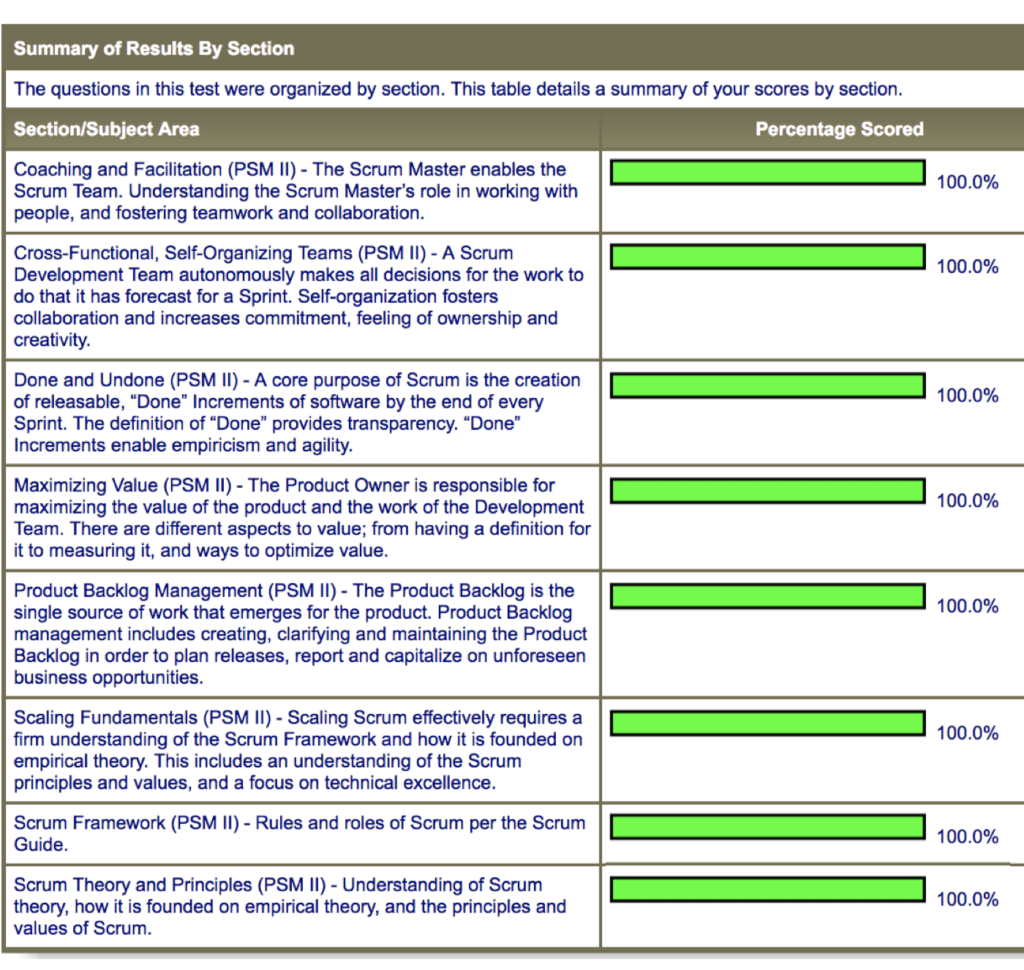
- Understanding and Applying the Scrum Framework (Empiricism, Scrum Values, Scrum Team, Scrum Events, Scrum Artifacts, Definition of Done)
- Developing People and Teams (Self-Managing Teams, Facilitation, Leadership Styles, Coaching and Mentoring)
- Managing Products with Agility (Product Backlog Management, Stakeholders and Customers)
- Developing and Delivering Products Professionally (Managing Technical Risk)
- Evolving the Agile Organization (Organizational Design and Culture)
Advanced Topics Covered
The PSM II exam emphasizes advanced concepts including:
- Scrum Master Stances: Understanding the various roles a Scrum Master embodies.
- Scaling Fundamentals: Basic knowledge of the Nexus Framework for multi-team scenarios.
- Evidence-Based Management: Understanding value measurement and organizational improvement.
- Stakeholder Management: Managing complex stakeholder dynamics and conflict resolution.
- Organizational Change: Helping organizations adopt agile practices effectively.
Essential Study Materials
The Scrum Guide 2020: The foundational document that must be thoroughly understood, with particular focus on empiricism, Scrum values, and the Scrum Master’s accountabilities. The 2020 version introduced key concepts like self-managing teams and refined role definitions.
The Nexus Guide: Essential for understanding scaled Scrum environments and how multiple teams work together. PSM II includes questions about scaling fundamentals, making this guide crucial for preparation.
Official Learning Resources
Scrum Master Learning Path: Structured content from Scrum.org that provides comprehensive coverage across all focus areas, emphasizing practical application over theoretical knowledge.
PSM II Certification Exam Details
- Fee: $250 USD
- Passing score: 85%
- Time limit: 90 minutes
- Number of Questions: 30 (partial credit provided on some questions)
- Difficulty: Advanced
- Format: Multiple Choice, Multiple Answer, and True/False
- Language: English only
- Renewal: Not Required
Question Types and Difficulty
The exam features scenario-based questions that present real-world situations requiring you to apply advanced Scrum concepts. Approximately 50–60% of questions are situational, drawing from complex organizational challenges and scaling scenarios. Question types include:
- Single-answer multiple-choice questions.
- Multiple-select questions with specified number of answers.
- True/false questions (minimal).
- Scenario-based questions with complex business situations.
The questions are significantly longer than PSM I, requiring careful reading and deep understanding of Scrum principles. Many questions focus on “what would you do as a Scrum Master” in specific challenging scenarios rather than direct knowledge recalls.
PSM II Certification Exam Tips & Tricks
- Go through the
Open Assessments
of Scrum.org: Scrum Open, Product Owner Open, Nexus Open, Scrum with Kanban Open, Agile Leadership Open, and Developer Open. - Read
8 Stances of a Scrum Master,
Scrum Master Anti-Patterns, and
Books
suggested by Scrum.org. - Understand topics like Coaching & Facilitation, Scrum Values, good vs bad coaching, and how to guide teams to solutions.
- Read the
Scrum Guide
and the
Nexus Guide
thoroughly.
Review these tips again before the assessment:
- Watch the clock. Time moves faster than in mock tests — don’t waste it!
- Mark only questions you truly want to revisit. You may only realistically review 2–3.
- Be rested and alert. A good night’s sleep is key.
- Rely on your knowledge. Many questions are situational, asking what action a Scrum Master would take.
- There are fewer ‘right’ and ‘wrong’ answers — more ‘better’ or ‘less optimal’ choices.
Tip: Eliminate obviously wrong options first, but be alert — PSM II traps are subtle. - Read questions slowly or aloud. Words like “may” vs “can” can change meanings.
- Always read all answer choices — don’t pick the first one that seems right.
Common Challenges
- Time Management: 90 minutes for 30 complex questions means you must pace yourself.
- Subtle Distinctions: Choose the most appropriate answer among several plausible ones.
- Organizational Context: Think beyond individual Scrum teams — consider wider org impact.
Blogs and Articles
- There is value in the Scrum values
- How to kickstart a great Scrum Team?
- The 10 Commandments of Egoless Programming
- Scrum from the Trenches – The Sprint Goal
- Liberating Structures: Unleash and Involve Everyone
- 14 Stances of Highly Effective Product Owners
- The Evolution of the Agile Manager
- The Scrum Master as the Change Agent
- 17 Common Scrum Myths
- Scrum Glossary
Purchase PSM II Practice Exam (240 Questions): Click Here for UDEMY Membership.
Disclaimer: Professional Scrum™, Professional Scrum Master, PSM, PSM I, Professional Scrum Product Owner, PSPO, PSPO I, Scrum Open, etc. are protected brands of Scrum.org. Our content and practice exams are neither endorsed by nor affiliated with Scrum.org. Scrum Guide content is sourced from
scrumguides.org
under the Attribution ShareAlike license (CC BY-SA 4.0). Details at
creativecommons.org/legalcode and
summary.

